Celtic’s Boardroom “Refresh” – Real Change Or Just Two More Names Around The Same Table? Don’t Hold Your Breath.
 Bhoycie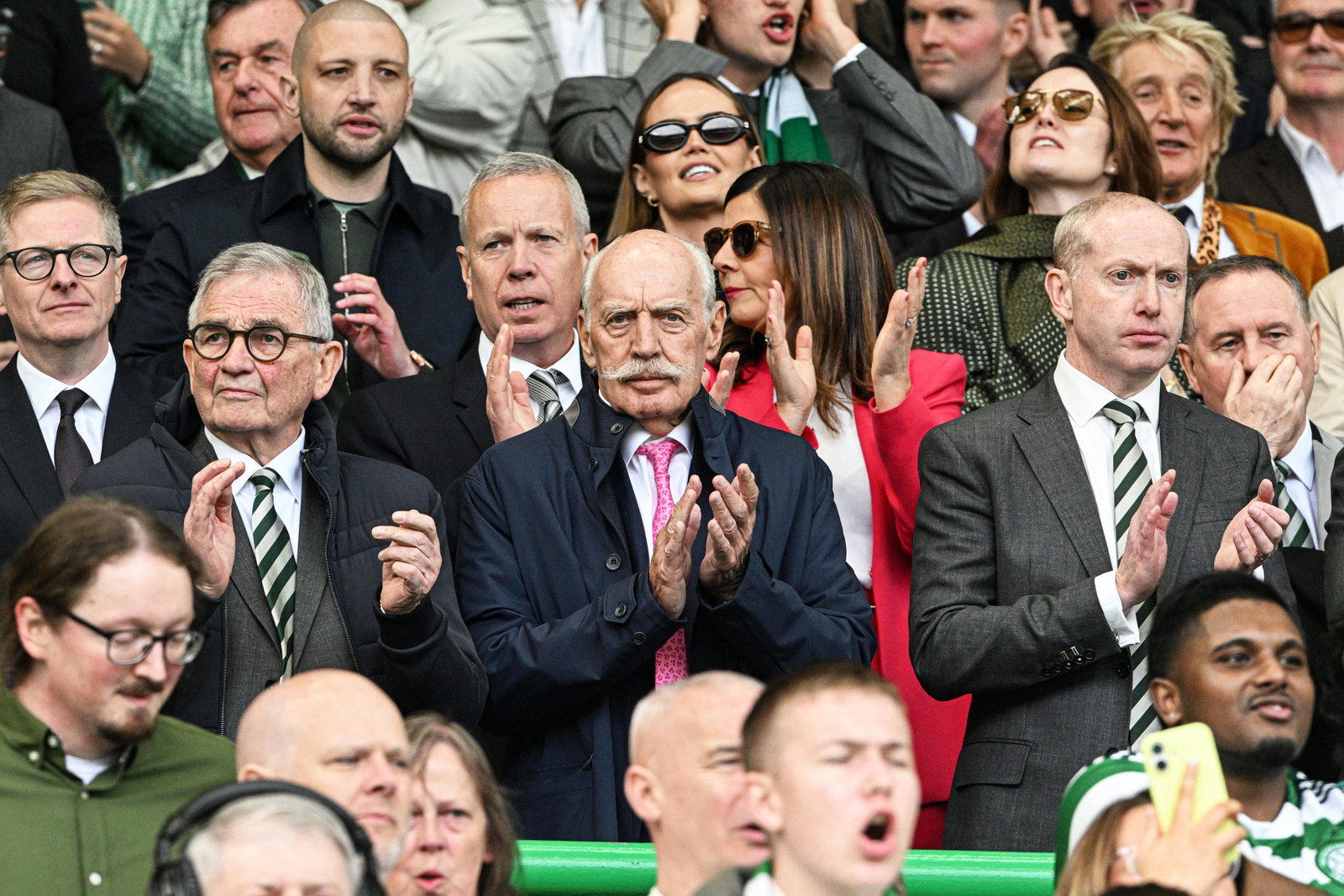
(left to right) Interium Chairman Brian Wilson, Non Executive Director Dermot Desmond and Michael Nicholson Chief Executive Officer of Celtic during the William Hill Premiership match at Celtic Park, Glasgow 16/05/2026 ============================================= Use the following embed code to publish this image online: <smartframe-embed customer-id="e8c3ce70f1ad837bdffb21e2453272b6" image-id="XhXPcz8qsRFp" style="width: 100%;display: inline-flex;max-width: 7007px;aspect-ratio: 7007/4671"></smartframe-embed> More info: at https://smartframe.io/embedding-support/
Celtic have announced two new additions to the boardroom.
Mark Keane and Raymond Buchanan have been appointed as non-executive directors, filling the vacancies left by the departures of Peter Lawwell and Tom Allison.
Interim chairman Brian Wilson says the appointments form part of a continuing “board refreshment” process and that both men will bring “new ideas and insights” to Celtic.
Good.
I genuinely wish both of them every success.
Because Celtic desperately need new ideas.
But forgive me if I’m not hanging out the bunting just yet.
We have heard plenty about change, modernisation and new direction at Celtic before. What supporters need now isn’t another announcement telling us things are changing.
We need evidence that they actually are.
And before deciding whether these appointments represent meaningful change, there is one fairly obvious question that needs answered.
What does a non-executive director actually do?
Non-Executive Doesn’t Mean Powerless.
I think there’s probably a misconception among football supporters — and I’ll include myself in that — that a non-executive director is essentially someone who turns up for meetings, gets handed the biscuits and nods occasionally.
That’s not really how it’s supposed to work.
A non-executive director doesn’t manage the everyday operation of a company. They’re not picking Celtic’s team, negotiating transfers or running Lennoxtown.
Their role is different.
They’re there to scrutinise executives, contribute towards strategy, provide independent judgement and, crucially, challenge the people actually running the business.
Celtic’s own annual reports make the governance structure pretty clear.
Potential board appointments are considered through the Nomination Committee, which makes recommendations to the board, while the club has previously stated that candidates should possess the experience, skills and knowledge capable of furthering the interests of Celtic and its shareholders.
So Keane and Buchanan absolutely can make a difference.
The question isn’t whether non-executive directors have influence.
They can.
The question is whether these particular non-executive directors are being brought into Celtic to challenge the existing direction or simply become two more names around the same table.
Because Celtic don’t need more passengers.
They need people willing to ask difficult questions.
But Who Is Actually Driving The Change?
That brings me to Brian Wilson.
Wilson became interim chairman following Peter Lawwell’s departure at the end of December 2025.
Celtic announced Lawwell’s decision to stand down on December 17, with Wilson subsequently taking over on an interim basis.
We’re now in September.
Nearly nine months later, Celtic still have an interim chairman.
That’s quite some interim.
And Wilson is now announcing the next stage of a “board refreshment” programme.
Again, fine.
But surely supporters are entitled to ask what the ultimate destination of this refresh actually is?
Who’s going to be the permanent chairman?
When will that appointment happen?
What exactly is changing beyond personnel?
And perhaps most importantly, who is deciding what the new Celtic is supposed to look like?
Today’s announcement tells us Keane and Buchanan will bring new ideas and insights and that further board refreshment will follow.
Excellent.
What it doesn’t yet demonstrate is a fundamental change in Celtic’s direction of travel.
I am not holding my breath, why should I.
We’ve Heard “Modernisation” Before.
If Celtic supporters need a reminder about why some of us are sceptical, cast your mind back to 2021.
Dominic McKay arrived from Scottish Rugby to replace Peter Lawwell as chief executive.
McKay spoke publicly about Celtic needing to modernise, evolve and develop.
Those were exactly the sort of words supporters wanted to hear.
This was supposed to be a new Celtic.
Fresh thinking. A different approach. Modernisation.
His full-time tenure lasted 71 days.
Celtic said McKay left for personal reasons, and it’s important to state that there has never been definitive public evidence establishing that he departed because Celtic rejected his ideas.
So I’m not going to pretend there is.
But the sequence of events remains extraordinary.
A chief executive arrives talking enthusiastically about modernising Celtic and, little more than two months after officially taking control, he’s gone.
They didn’t really want it. They are all for self preservation. Protecting their own jobs at all costs and not being exposed for their failings by some forward thinking, ambitious new kid on the block.
That episode should remain in the minds of supporters when we’re told about new ideas arriving in the Celtic boardroom today.
We’ve heard it before.
The test isn’t whether new ideas enter Celtic Park.
It’s whether they’re allowed to survive there.
Then There Is Dermot Desmond.
Here’s where the term “non-executive director” becomes particularly interesting.
Dermot Desmond is one himself.
He’s been a Celtic non-executive director since May 1995.
So anyone thinking Keane and Buchanan can’t wield meaningful influence simply because they’re NEDs should probably consider the influence supporters have long associated with Celtic’s largest individual shareholder.
Desmond is not Celtic’s majority shareholder.
That’s an important distinction.
With Lawwell, now departed, that creates another perfectly reasonable question.
What does Celtic’s governance structure look like now, and who drove these latest appointments?
I’m not going to tell you Dermot Desmond personally selected Mark Keane and Raymond Buchanan because I don’t have evidence to support that, but after his recent antics the past 12 months who can’t be forgiven for being suspicious.
But Celtic supporters are perfectly entitled to ask how much has genuinely changed in the power structure of their football club.
That’s not conspiracy.
That’s accountability.
Is Mark Keane Really An Outsider?
There’s another interesting element to one of the appointments.
Is nepotism at play yet again?
Mark Keane isn’t exactly arriving at Celtic without existing ties.
He’s a lifelong supporter and already a significant shareholder in Celtic.
Celtic’s 2023 annual report listed James Mark Keane as holding 5,909,847 ordinary shares — 6.25% of the issued ordinary share capital at that time.
His family connection to Celtic is substantial too.
John Keane – he served as non-director for more than 20 years and was named honorary chairman in 2013.
But if today’s announcement is being presented as evidence of completely new blood sweeping through Celtic Park, it’s worth acknowledging that one of the appointments is already a substantial shareholder with deep historical connections to the club.
Raymond Buchanan is perhaps the more obviously different appointment.
His career has included senior corporate affairs and communications positions, and Celtic say that professional experience can help strengthen relationships across the “Celtic Family”.
Given the catastrophic deterioration in the relationship between Celtic’s board and sections of the support, somebody capable of improving communication certainly shouldn’t be short of work.
I hope they challenge Dermot Desmond.
And I hope they challenge the culture that has allowed Celtic to become so painfully reactive when we should be Scotland’s most progressive football club.
Because that is what a good non-executive director can do.
But I’m not going to declare a new dawn because Celtic have issued a press release.
We’ve done this dance before.
Too often with Celtic it’s all skirt and no knickers.
A big announcement. Nice words. Talk of progress, talk of modernisation, talk of a new direction.
Then six months later you look around and wonder what actually changed.
Celtic supporters don’t need a rebrand of the existing boardroom.
They need genuine structural change.
And until supporters actually see evidence of that change, Celtic can call this a “board refreshment” as often as they like.
The rest of us are perfectly entitled to wait and see whether anything has actually been refreshed.
Keep Your Eyes On The Board.