
Martin O’Neill Can Reject The Jekyll And Hyde Label All He Likes But Celtic’s Results, Formations And Performances Tell A Different Story
 Bhoycie

Martin O’Neill has rejected the suggestion that Celtic are a Jekyll and Hyde football team.
I understand why.
No manager wants his side described as unpredictable, inconsistent or incapable of maintaining a recognisable level of performance. O’Neill is entitled to defend his players, particularly when he can point towards eight victories from nine Premiership matches.
But there’s a rather obvious problem with that defence.
The results might suggest consistency. The performances tell a completely different story.
And if Martin believes supporters are going to overlook what they’ve witnessed simply because Celtic have collected league points, he’s badly mistaken.
From European Humiliation To Domestic Domination
Let’s examine the results in order, because they tell a fascinating story.
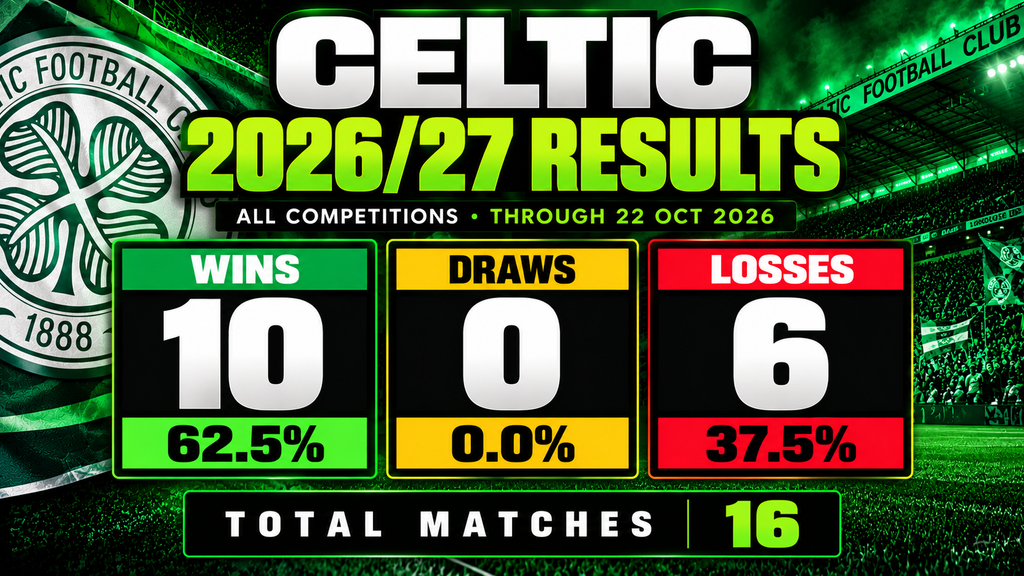
On 19 August, Celtic defeated LASK 3-0 at Paradise in the first leg of their Champions League play-off.
Six days later, they travelled to Austria and suffered a humiliating 5-1 defeat, crashing out of the competition.
What happened next?
Celtic returned to domestic football and defeated Falkirk 2-1, before beating Aberdeen 3-0, St Mirren 2-1 and St Johnstone 1-0.
Four consecutive victories.
Yet anybody watching those matches knows they weren’t four equally convincing performances.
Then came September.
Celtic travelled to Ibrox for a League Cup quarter-final and were dismantled 3-0 by Rangers.
Four days later, Ferencváros arrived at Celtic Park and inflicted another defeat, winning 3-1.
Three days after that, Rangers returned to Paradise and won 1-0.
Three consecutive defeats.
Ironically, that might have been the most consistent Celtic have looked all season.
Unfortunately, they were consistently poor.
There was no dramatic transformation between those matches. No sudden emergence of an unmistakable footballing identity.
Just three defeats that exposed how vulnerable Celtic had become.
Then Came Another Remarkable Contrast
After the international break, Celtic returned with a 2-0 victory at Motherwell.
A welcome result, certainly, but hardly proof that every problem had disappeared.
Four days later, Benfica put four past us in Lisbon.
Celtic lost 4-1.
Then, almost unbelievably, Hearts arrived at Paradise and were hammered 7-1.
Seven goals!
Suddenly, Celtic looked capable of producing attacking football with pace, confidence and purpose.
Supporters were understandably delighted.
But what followed?
Celta Vigo visited Celtic Park on Thursday night and won 2-1.
So consider that sequence.
A 2-0 victory at Motherwell. A 4-1 defeat to Benfica. A spectacular 7-1 victory over Hearts. Another European defeat against Celta Vigo.
If that isn’t a compelling illustration of Jekyll and Hyde performances, I’d be interested to hear what is.
Eight Wins From Nine Doesn’t Tell The Whole Story
O’Neill is perfectly entitled to highlight Celtic’s domestic record.
Eight wins from nine league matches is a strong return.
Nobody is disputing that.
Celtic have collected points in games where their football has been unconvincing. They’ve produced outstanding attacking performances and followed them with displays that have supporters questioning everything from the midfield balance to the defensive organisation.
That’s the distinction Martin needs to acknowledge.
The league table records victories, draws and defeats.
Supporters remember what actually happened during those 90 minutes.
And this season, the gap between Celtic’s results and the quality of their performances has been enormous.
Does Anybody Know What Formation Celtic Will Play?
There’s another element to this debate that makes the Jekyll and Hyde description entirely understandable.
Celtic’s tactical identity has become almost impossible to predict.
I’ve followed this club for years, and I genuinely cannot remember another season when so many supporters have spent so much time debating what formation Celtic might use before a match.
Will it be a back three?
Will we start with four defenders?
Where will the midfielders operate?
Are we playing with conventional wide players, wing-backs or something entirely different?
These aren’t questions supporters are asking because they enjoy discussing tactical diagrams.
They’re asking because nobody seems entirely certain what Celtic are trying to become.
The defeat against Rangers was a particularly striking example.
I cannot remember watching Celtic experiment with so many different shapes and approaches during a single match.
Changes in formation are sometimes necessary. Managers must respond to opponents, injuries and developments during games.
But there’s a difference between tactical flexibility and tactical uncertainty.
One demonstrates control.
The other can create confusion.
And Celtic have looked confused far too often.
A Manager Needs A Recognisable Identity
I’ve argued previously that having a clearly defined football philosophy actually provides a manager with protection.
Think about Ange Postecoglou.
Whatever anybody thought of his methods, supporters understood what he wanted Celtic to do.
There was a recognisable approach.
Even when results disappointed, we could identify the football Celtic were attempting to play.
Can we say the same about this side?
I’m not convinced.
What is Celtic’s preferred formation?
Does the team have a defining tactical characteristic?
Those should be relatively straightforward questions to answer about a football club with ambitions of competing in Europe.
Instead, supporters are left debating them almost every week.
And when players themselves have spoken publicly about randomness and losing control of matches, the concerns become considerably harder to dismiss.
Martin Can’t Dismiss What Supporters Are Watching
I have no problem with O’Neill defending Celtic.
That’s part of his job.
Nor am I suggesting that every tactical change is a mistake or that one formation would magically solve every weakness in this squad.
But there’s a point where defending your team becomes an attempt to explain away the obvious.
Celtic have been inconsistent in their performances.
They’ve been inconsistent in their shape.
Their formations have been unpredictable, and their approach has varied dramatically between matches.
Sometimes, we’ve barely recognised the team that produced such convincing football only days earlier.
Martin can point towards eight league victories from nine.
I’ll acknowledge every one of them.
But he cannot expect supporters to ignore the bigger picture.
When your most consistent run of performances is three consecutive defeats, and a 7-1 victory is followed immediately by another European loss, Jekyll and Hyde isn’t an unfair description.
It’s an entirely understandable one.
And Celtic supporters aren’t going to have the wool pulled over their eyes simply because the league table makes more comfortable reading than the performances themselves.