
Celtic Connect – Eleven Supporters, Four Meetings And A Board Still Desperate To Control The Conversation
 Bhoycie
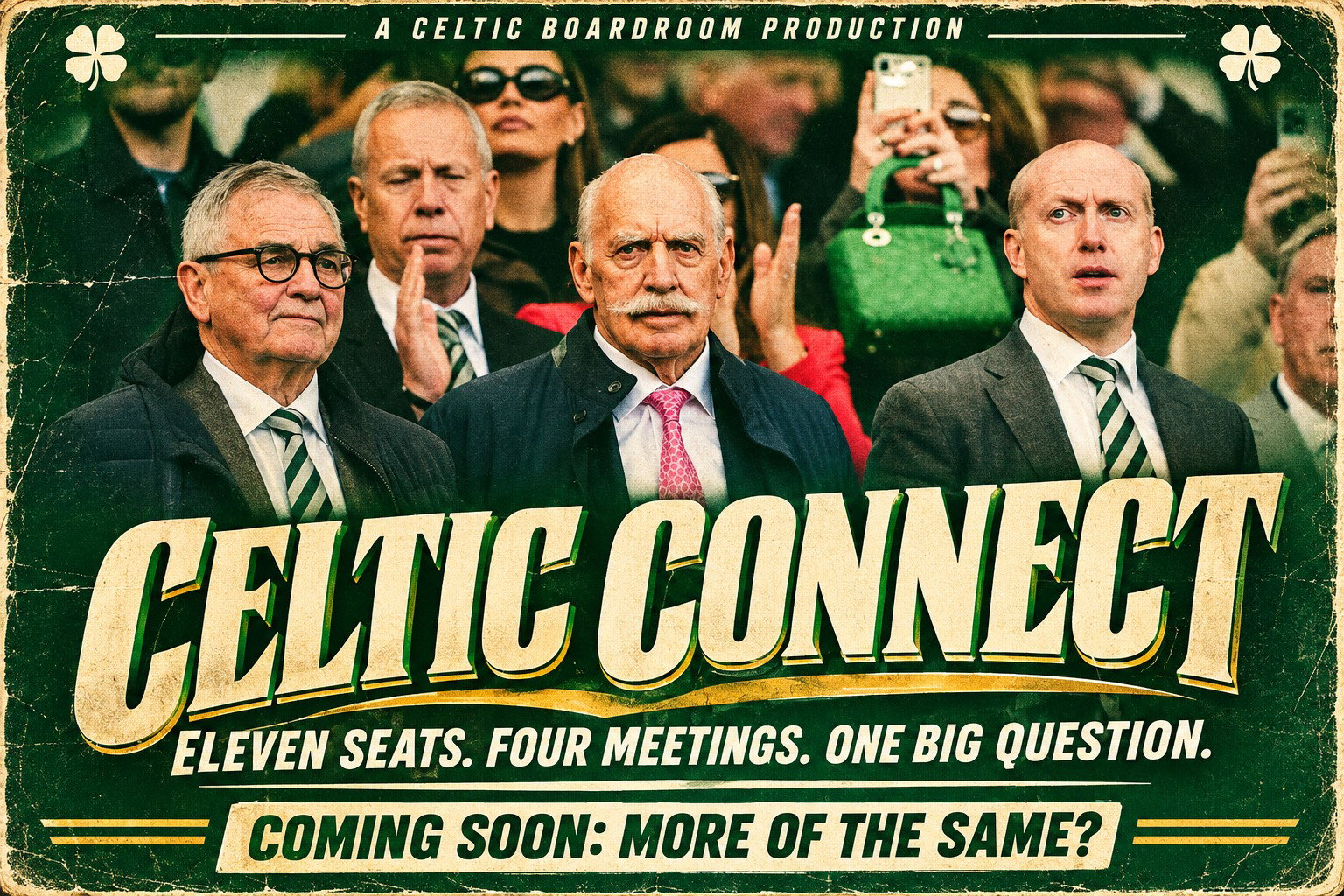
Celtic have announced changes to their proposed Celtic Connect supporter engagement initiative, and apparently we’re now supposed to believe meaningful dialogue between the club and its supporters is just around the corner.
Forgive me for not immediately breaking out the champagne.
Following a consultation period, Celtic have increased the proposed number of supporter representatives, altered the membership criteria and promised more frequent meetings.
On paper, some of these changes are perfectly sensible. In fact, there are elements of the proposal I’d genuinely welcome if the club follows through on them.
Unfortunately, we’ve become rather familiar with Celtic promising improvements, asking supporters for another chance and eventually reverting to type.
So rather than getting carried away with another glossy announcement, I’ve decided to examine all ten points Celtic have outlined.
Because if this is genuinely the beginning of a new relationship between the board and the support, the details matter considerably more than the presentation.
Eleven Representatives: But Who Gets To Choose Them?
Celtic have increased the proposed supporter membership from nine to eleven.
Wonderful. Two extra chairs around the table.
But what difference does that actually make if supporters aren’t the people choosing who occupies them?
The original proposal involved a selection panel comprising a Celtic board member, Head of Supporter Engagement John Paul Taylor and a former player.
Nothing in the latest announcement identifies a change to that arrangement.
Celtic could invite fifty supporters into the room, but if the club retains control over selecting its representatives, the fundamental question remains unanswered.
Who exactly are these individuals accountable to?
Supporter representation isn’t about filling seats. It’s about ensuring the people occupying them are prepared to challenge the board, ask uncomfortable questions and refuse to accept corporate nonsense.
Eleven carefully selected voices aren’t automatically more representative than nine.
Apparently, The North Stand And South Stand Needed Different Opinions
Another change removes the original requirement for season ticket representatives to come from particular stands.
Quite how Celtic arrived at that idea in the first place remains a mystery.
What exactly was somebody in the North Stand supposed to contribute to a discussion about Celtic’s European ambitions that somebody in the Jock Stein Stand couldn’t?
We’re discussing the future of Celtic Football Club, not organising a neighbourhood watch scheme.
The rail seating section, admittedly, has specific matchday concerns that warrant discussion. Nevertheless, dividing the wider support according to where they happen to sit always struck me as bizarre.
Credit to Celtic for abandoning it.
Although congratulating somebody for correcting an unnecessarily complicated idea they introduced themselves feels rather generous.
More importantly, Celtic have changed where potential representatives can sit.
Have they changed who gets to choose them?
Because changing the seating arrangements while leaving the bigger issue unresolved looks suspiciously like rearranging the deckchairs.
Supporting Celtic Isn’t A Loyalty Scheme
Celtic have also introduced a place for a non-season ticket holder who attends matches.
That’s an improvement, but once again, I find the eligibility criteria peculiar.
I’ve supported Celtic my entire life. I watch every game I possibly can, follow the club obsessively and spend a considerable amount of my time discussing everything happening at Celtic Park.
Yet because I don’t attend matches, I apparently wouldn’t qualify for this particular position.
My co-driver on The Bhoycie Bus, Marc, is a season ticket holder. I’m not.
We’ve spent countless hours discussing Celtic, both privately and through The Bhoycie Bus, and neither of us has ever considered the other’s opinion less valuable because of where we watch the football.
So why should Celtic?
Supporting a football club isn’t a transaction.
Plenty of supporters cannot attend matches because of work, finances, family commitments, geography or any number of perfectly reasonable circumstances.
Their opinions don’t suddenly become less relevant.
Instead, Celtic’s approach almost resembles a loyalty scheme.
Congratulations on being a paying customer. You’ve now earned the opportunity to apply for our exclusive supporters’ club.
Surely we can do better than that.
Four Meetings A Year? Fine. But Let’s Talk About Timing
Celtic Connect will now meet four times annually.
I’ve actually got no problem with that.
Quarterly meetings seem perfectly reasonable, provided they’re scheduled with a bit of common sense.
Personally, I’d insist that two take place within the first week after the January and summer transfer windows close.
What better opportunity to question Celtic about recruitment, expenditure, departures and whether the football squad has genuinely improved?
Not halfway through July, when the board can trot out the usual assurances about working tirelessly behind the scenes, identifying targets and doing everything possible to strengthen the team.
We’ve heard all that before.
Get them around a table when the windows have closed, the business is finished and supporters can judge what has actually been delivered.
Somehow, I suspect Celtic would find it considerably more convenient to arrange meetings when there’s still plenty of time to promise things rather than when it’s time to explain what happened.
Four meetings are absolutely fine.
Four meetings conveniently scheduled to avoid the most difficult questions would be another matter entirely.
Rotating Membership Or Filtering Membership?
Celtic have introduced a three-year membership arrangement, with approximately a third of representatives changing annually.
Again, there’s nothing inherently wrong with that.
Fresh voices and new perspectives should be encouraged, while continuity can help ensure discussions don’t constantly return to square one.
But as I quipped on Trinity Tims on Monday, I can already imagine how this might work.
Those who spend their first year nodding politely, agreeing with everything and avoiding uncomfortable questions might find themselves rather welcome around the table.
Meanwhile, anyone who has the audacity to challenge Michael Nicholson, question the board’s decisions or generally step out of line could suddenly discover their time is up.
Will Celtic Connect operate a rotating membership, or could it become a filtering process?
There’s a considerable difference between refreshing supporter representation and quietly removing the people who ask questions the club would rather not answer.
The club needs to explain how that annual rotation will operate.
Otherwise, suspicion will fill the gaps left by the announcement.
Celtic’s Strategic Vision? We’ll Be All Ears
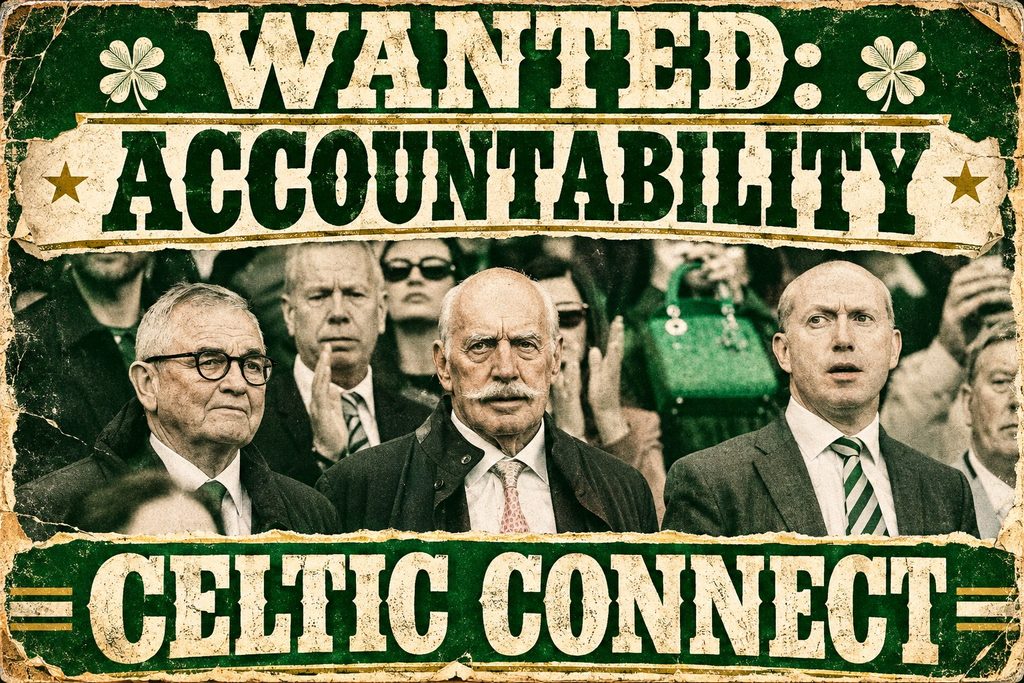
Now we’re getting to the really interesting stuff.
Celtic Connect will consider the club’s strategic vision and objectives.
Well, we’ll certainly be all ears for this one.
Whatever Celtic have been operating under in recent years, it certainly hasn’t looked much like a coherent football strategy to me.
Instead, it’s increasingly resembled a business model designed to protect the KPIs of the guys in the ties rather than deliver meaningful progress on the pitch.
Charlie Methven recently questioned whether Celtic’s strategy was so poor that the club was reluctant to disclose it, or whether there was any meaningful strategy at all.
It’s a question worth asking.
Now, if Celtic Connect genuinely opens the door to proper transparency about the club’s objectives, fantastic.
Lay out the plan.
Tell supporters what Celtic want to achieve, how success will be measured and when those targets are supposed to be delivered.
Give us something tangible against which we can judge the people running our football club.
I’ll happily welcome that development.
But there’s one important condition.
Once Celtic have told us what the strategy is, don’t expect supporters to forget about it.
We’ll be holding the club to the objectives it sets itself.
If the board genuinely wants that level of accountability, I’ll be delighted.
It would represent quite a departure from what we’ve become accustomed to.
Celtic’s Heritage Should Build Its Future
Another proposed discussion area concerns Celtic’s heritage and history.
This could go one of two ways.
We could have another exercise in self-congratulation, with everybody sitting around patting themselves on the back about our magnificent history.
Or Celtic could demonstrate some actual ambition.
Our origins, charitable foundations, the Lisbon Lions and everything that makes this football club different represent a story deserving of recognition far beyond Glasgow.
Celtic already have supporters clubs across the world.
Why should the ambition stop with people who already support us?
Imagine a serious international initiative to introduce Celtic’s story to new audiences, new countries and football supporters who might otherwise never have considered following the club.
There’s enormous potential to grow our worldwide support and, yes, our customer base.
Surely that’s something the commercially minded individuals in the Celtic boardroom should find appealing.
What about a proper Celtic museum?
Somewhere that celebrates our history, tells our story and becomes a genuine attraction for supporters and visitors alike.
These are the sorts of projects I’d love to see discussed.
Our history shouldn’t simply be something Celtic look back on with pride.
It should be something the club actively uses to build its future.
If that’s the ambition, I’m all for it.
If we’re merely arranging another opportunity to congratulate ourselves on the achievements of previous generations, we’re missing the point entirely.
Broader Supporter Engagement? You’re Having A Laugh
This might be the most extraordinary contradiction in the entire proposal.
Celtic want to discuss broader supporter engagement.
Wonderful.
They’ve generously increased their proposed representatives from nine to eleven.
Meanwhile, the club has already announced that it will no longer recognise or engage with the Celtic Fans Collective, a coalition bringing together numerous elements of the support.
So let me get this straight.
We’re broadening supporter engagement by refusing to engage with an established coalition of supporters while creating a new committee whose representatives are chosen through a process involving club officials?
That’s certainly one interpretation of the word broader.
The Celtic Fans Collective might ask uncomfortable questions.
Its members might challenge decisions, demand accountability or refuse to accept the usual explanations.
But isn’t that precisely what meaningful supporter engagement should involve?
Instead, Celtic Connect risks looking like a carefully selected committee of individuals the club considers suitable for conversation.
You cannot credibly claim to be broadening supporter engagement while simultaneously deciding that a substantial coalition of supporters is no longer welcome at the table.
Celtic don’t need eleven people who know how to behave themselves in a boardroom.
They need representatives who are prepared to challenge the people sitting on the other side of it.
Otherwise, this becomes less about supporter engagement and more about supporter management.
Celtic Park Development: Did We Really Need A Committee For This?
Celtic Park development and the matchday experience are also on the agenda.
Seriously, do we now need to establish Celtic Connect before somebody at the football club notices that our stadium requires investment?
Surely improving Celtic Park should be an ongoing responsibility of the people already employed to run the place.
Celtic will undoubtedly point towards the Celtic Way and other projects they’ve undertaken.
That’s fine.
But what about the ageing main stand?
What about the complaints over something as basic as running hot water?
These concerns haven’t suddenly appeared overnight.
Then along come Oasis.
Five concerts at Celtic Park, bringing an enormous commercial opportunity and the prospect of the club earning millions of pounds.
Suddenly, the possibilities of using Paradise for major events beyond football become rather difficult to ignore.
Perhaps somebody might even consider hosting major concerts regularly.
What a revolutionary concept.
Forgive my cynicism, but it’s remarkable how quickly ambition can become fashionable when there’s a few million quid potentially attached to it.
Why weren’t we pursuing opportunities like these years ago?
I’d welcome Celtic Park becoming a regular destination for major acts.
Equally, I’d welcome a serious redevelopment plan that treats our stadium as something that should continually evolve.
Neither ambition should require eleven supporters sitting around a table to convince the board that investment and commercial imagination are good things.
And as for improving the matchday experience?
Here’s a suggestion that won’t cost Celtic a penny.
Stop banning your own supporters’ groups and then wondering why the atmosphere suffers.
You can improve catering, concourses and entertainment all you like.
None of it replaces the supporters who create the atmosphere that makes Celtic Park special.
Information Sharing: Words That Already Give Me The Fear
Finally, Celtic Connect will consider information sharing between the club and supporters.
Three words that already fill me with dread.
Because what exactly does that mean?
Will Celtic answer difficult questions, explain controversial decisions and provide information supporters would otherwise struggle to obtain?
Or will the club tell eleven carefully selected individuals precisely what it wants them to know, when it wants them to know it?
Forgive me, but I suspect we’re heading towards the latter.
Information sharing is meaningless if Celtic control the information, the questions and the answers.
The last thing supporters need is another quarterly helping of vague corporate jargon dressed up as transparency.
Celtic Connect Must Become More Than Another Tick-Box Exercise
So there we have it.
Five changes to the proposed structure, five areas of discussion and another opportunity for Celtic to convince supporters that things are finally going to change.
Are there positives here?
Absolutely.
I’ve highlighted them throughout, and I’d genuinely welcome meaningful progress.
But forgive me for not getting all dewy-eyed about Celtic suddenly undergoing some miraculous personality transplant.
We’ve been here before.
It’s remarkably similar to the familiar promises surrounding transfer windows.
Give us another chance. Trust the process. We’re working hard behind the scenes. Things will be different this time.
Then the window closes, the excuses begin and we find ourselves having the same conversations all over again.
Celtic Connect feels suspiciously like another exercise in ticking boxes.
Something the club can point towards as evidence that it’s listening, without necessarily changing anything about how it operates.
Of course, the proof will be in the pudding.
If Celtic genuinely intend to engage with supporters, publish a meaningful strategy, welcome difficult questions and demonstrate that supporter involvement can influence decisions, I’ll be the first to acknowledge it.
Until then, I’m extremely reluctant to celebrate another collection of promises from people who have given us precious little reason to believe they’ll follow through.
Celtic Connect might eventually prove to be a step in the right direction.
But right now, I can’t help feeling it’s nonsense of the highest order, dressed up as progress.
Eleven supporters sitting around a table won’t restore trust.
Only the people running Celtic can do that.
And they’ll have to earn it.
Keep Your Eyes On The Board.