Celtic Board Must Go: Europe Exposes Desmond’s Broken Model
Six consecutive Champions League qualifying failures and another dangerously thin squad leave Dermot Desmond and Celtic's long-serving board with nowhere left to hide.
 Phillip Cooney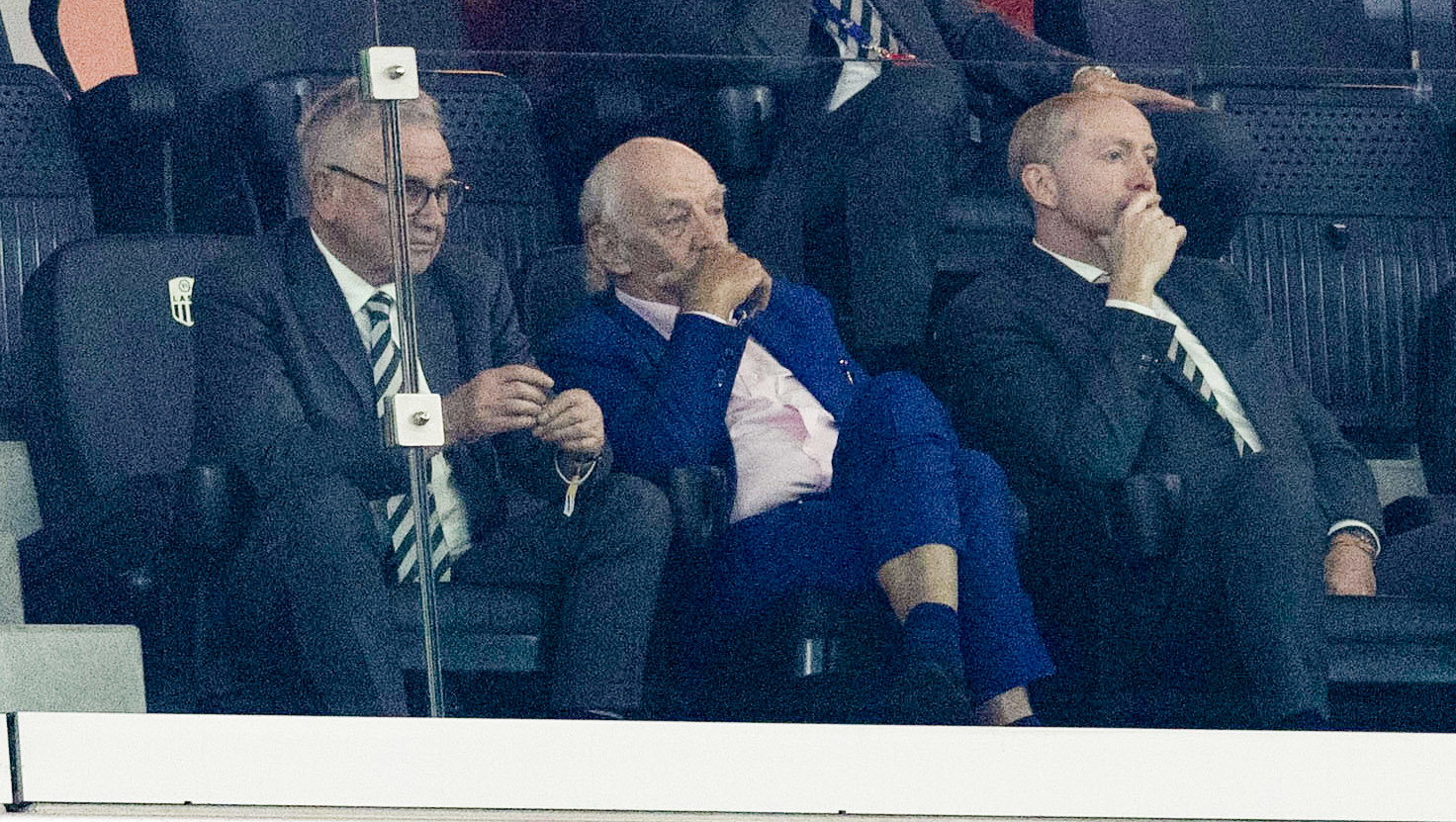
LINZ, AUSTRIA - AUGUST 25: (L-R) Celtic interim chairman Brian Wilson, majority shareholder Dermot Desmond and chief executive Michael Nicholson during a UEFA Champions League Play-Off Round Second Leg match between LASK and Celtic at Oberosterreich Arena, on August 25, 2026, in Linz, Austria. (Photo by Craig Williamson/SNS Group via Getty Images)
Celtic can win every domestic trophy available, but Europe is the benchmark for judging whether this board has actually moved the club forward.
After LASK, the verdict is brutal.
Celtic have now failed to negotiate six consecutive Champions League qualifying campaigns since last successfully coming through the process in 2017/18.
AEK Athens. CFR Cluj. Ferencváros. Midtjylland. Kairat Almaty. Now LASK.
These are not Real Madrid, Bayern Munich or Paris Saint-Germain.
Yet, year after year, Celtic reach the games that can define a season with glaring holes in the squad.
Dermot Desmond and a Celtic board built for yesterday
Dermot Desmond has been a Celtic plc director since 1995.
Brian Wilson joined the board in 2005 and is now interim chairman.
Michael Nicholson joined Celtic in 2013 and has been chief executive since 2021. Chris McKay has also been a director for around a decade.
This is not a new regime asking for time.
These are people who have had years to build a modern European football operation.
Celtic’s most recent published interim accounts showed £67.4million in cash.
Then Arne Engels was sold to West Ham for around £22million shortly before the LASK second leg.
Where was his established replacement?
Selling players is part of football. Selling one of your most valuable midfielders immediately before a Champions League play-off without a replacement ready is appalling planning.
Celtic squad depth was brutally exposed
Look at what Martin O’Neill was left trying to manage.
Alistair Johnston was attracting serious interest from Everton before injury intervened.
What was behind him?
Colby Donovan, a 19-year-old academy graduate, and Anthony Ralston.
Donovan deserves enormous credit. However, a teenager should not be carrying that level of responsibility because Celtic have failed to provide sufficient experienced depth.
Ralston gives everything for Celtic. In my view, though, he is not the required level if Champions League progress is genuinely the ambition.
Then the defence began falling apart.
Kieran Tierney was replaced after 71 minutes.
Donovan followed three minutes later.
Cameron Carter-Vickers was replaced at 90 minutes.
Three substitutions had therefore been used rebuilding a defence before extra time had properly begun.
Celtic ended up with Ralston, Dane Murray, Auston Trusty and Liam Scales across the back.
That is nowhere near the depth a club with genuine Champions League ambitions should accept.
Five midfielders for Celtic’s biggest game
Now look at midfield.
Callum McGregor.
Mika Baur.
Benjamin Nygren.
Reo Hatate.
Luke McCowan.
Five recognised midfield options in the matchday squad after Engels had been sold.
Baur had barely arrived and was still getting up to speed. Nygren faded as the game deteriorated.
McCowan, signed from Dundee, suddenly found himself being asked to help Celtic manage their way through a Champions League play-off collapse.
That isn’t McCowan’s fault.
It is an indictment of how the squad was constructed.
Up front, Celtic also looked increasingly toothless as the match went on.
Fresh legs were desperately required, yet O’Neill’s options were already being swallowed up by a defence that could not get through the night.
Europe exposes Celtic’s board
Perhaps the most damning part is the standard of opponent.
LASK entered the tie without a victory in their previous 11 UEFA matches.
Their previous European campaign had ended with them finishing 35th out of 36 teams in the Conference League league phase.
Celtic still surrendered a 4-0 aggregate advantage.
O’Neill made mistakes. The players deserve enormous criticism too. No Celtic side should ever lose that tie from such a commanding position.
However, managers change.
Players change.
Opponents change.
The people making the biggest decisions remain.
Domestic trophies cannot continually provide cover for European regression.
Europe is the benchmark.
Recruitment has modernised. Football operations have modernised. Successful clubs plan months ahead for decisive qualifiers.
Celtic still sell first, scramble later and gamble that the manager can somehow get through.
Six consecutive failed Champions League qualifying campaigns should end any argument that this is bad luck.
Dermot Desmond and this Celtic board have had long enough.
The club needs modern leadership, modern recruitment and a board capable of matching Celtic’s European ambitions.
Enough excuses.
It is time for change at the very top.