
 Aodhán Ó Conchobhair
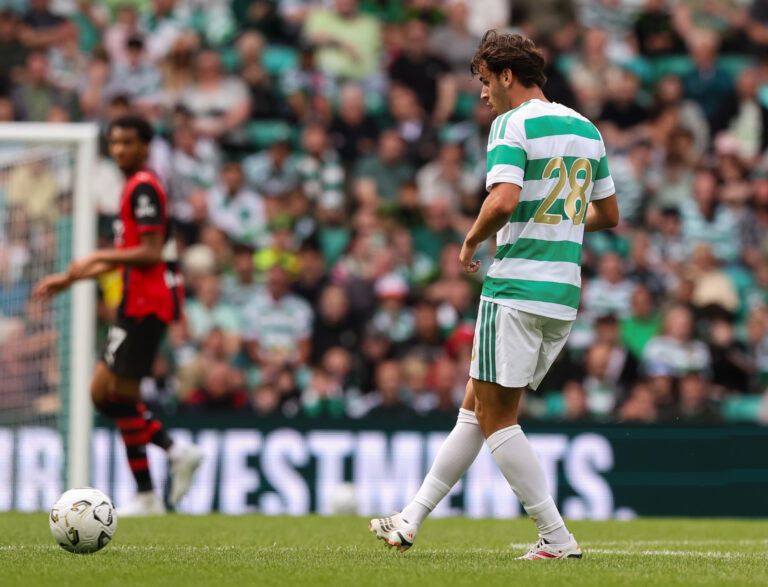
 When supporters think about Celtic’s transfer business and rumours this summer, the conversation often starts with wingers or strikers.
But as the final month of the transfer window begins, the club’s biggest concern may actually lie in the centre of the park.
Because quietly, Celtic’s midfield is beginning to look alarmingly thin.
A Midfield in Transition
Arne Engels continues to be linked with a move away.
Paulo Bernardo has reportedly been exploring opportunities elsewhere.
Reo Hatate’s future also remains uncertain, with speculation refusing to disappear.
Losing one of those players would be manageable.
Losing two would be difficult.
Losing all three would completely transform the picture of our midfield.
It’s a scenario Celtic simply cannot afford to leave until the final days of the transfer window.
Who Does That Leave?
Callum McGregor remains one of the best midfielders in Scotland, but he’ll turn 33 this season. He can still dictate games, but Celtic cannot continue relying on him to play every minute of every competition.
Alex Oxlade-Chamberlain brings experience, yet at 32 he is no longer the dynamic midfielder he once was in the Premier League.
Luke McCowan has proven himself to be an excellent squad player and a valuable member of the dressing room, but expecting him to replace the combined influence of Engels, Hatate and Bernardo would be asking too much.
Then there’s Benjamin Nygren.
The Swede has shown encouraging signs, particularly with his eye for goal and willingness to arrive in dangerous positions.
But he isn’t a natural controller of games.
He’s not the player who drops deep, dictates tempo or constantly progresses possession through the thirds.
He’s a different type of midfielder entirely.
If anything, Nygren’s strengths make it even more important that Celtic surround him with players capable of controlling matches.
The Right Profiles Are Emerging
Encouragingly, the club appears to recognise the issue.
Celtic have pushed hard to sign Mika Baur, a technically gifted midfielder capable of playing centrally or from wide areas.
Although that move has slowed in recent days, it demonstrates the type of player O’Neill is targeting.
Meanwhile, reports linking the Hoops with Rapid Vienna’s Tobias Gulliksen also make plenty of sense.
At 22, the Norwegian combines creativity with athleticism and has already gained valuable European experience. He fits the recruitment profile that has emerged this summer—young enough to develop further, but experienced enough to contribute immediately.
Neither player would simply replace what Celtic already have.
Gvidas Gineitis has also been linked, but for 15 million. I’m not too sure how much believe those links.
They would refresh a midfield that increasingly feels as though it is approaching the end of one cycle and the beginning of another.
The Clock Is Ticking
Perhaps the biggest concern isn’t the quality of the targets.
It’s the timing.
If Engels leaves, Celtic cannot spend three weeks searching for a replacement.
If Hatate departs, there must already be a succession plan in place.
The same applies if Bernardo moves on.
Waiting for departures before accelerating recruitment has been a criticism levelled at Celtic in previous windows, and it’s one the club cannot afford to repeat.
The midfield is the engine room of any successful side.
Get it right, and everything else becomes easier.
Get it wrong, and even the strongest attack can struggle to function.
The Window Will Be Defined Here
Kasper Høgh and Camilo Durán have given supporters reasons for optimism.
Both appear to be smart additions who improve the squad.
But if Celtic are to emerge from this transfer window stronger than they entered it, the next phase of recruitment must focus on midfield.
Replacing talent is never easy.
Replacing leadership, creativity and control is even harder.
That’s why the biggest transfer battle over the next few weeks won’t be finding another winger or another striker.
It will be ensuring that, when the window closes, Celtic still possess a midfield capable of dominating Scottish football and competing on the Champions League stage.
Because if the middle of the park weakens, everything else becomes that little bit harder.
Key Takeaways
- Celtic’s midfield appears alarmingly thin, with uncertainty surrounding key players like Arne Engels and Reo Hatate.
- Callum McGregor and Alex Oxlade-Chamberlain offer experience, but reliance on them raises concerns about depth.
- Celtic is targeting younger players like Mika Baur and Tobias Gulliksen to refresh the midfield and maintain competitiveness.
- Timing is crucial; the club must act quickly to secure replacements before potential departures occur.
- To succeed in the transfer window, Celtic must focus on retaining a strong midfield capable of dominating both domestic and European competitions.
 Eric Knott
 Bhoycie
 Phillip Cooney


Celtics immediate concern is a goalkeeper,what if sinisalo gets injured,it would be a catastrophe,we should have had a goalkeeper lined up when schmeichel retired.