
Celtic Board: Is There Anybody Prepared To Say No To Dermot Desmond?
Dermot Desmond may be Celtic's largest shareholder, but the club has a CEO, CFO, chairman and board. So who provides the challenge when Celtic's strategy is not working?
 Phillip Cooney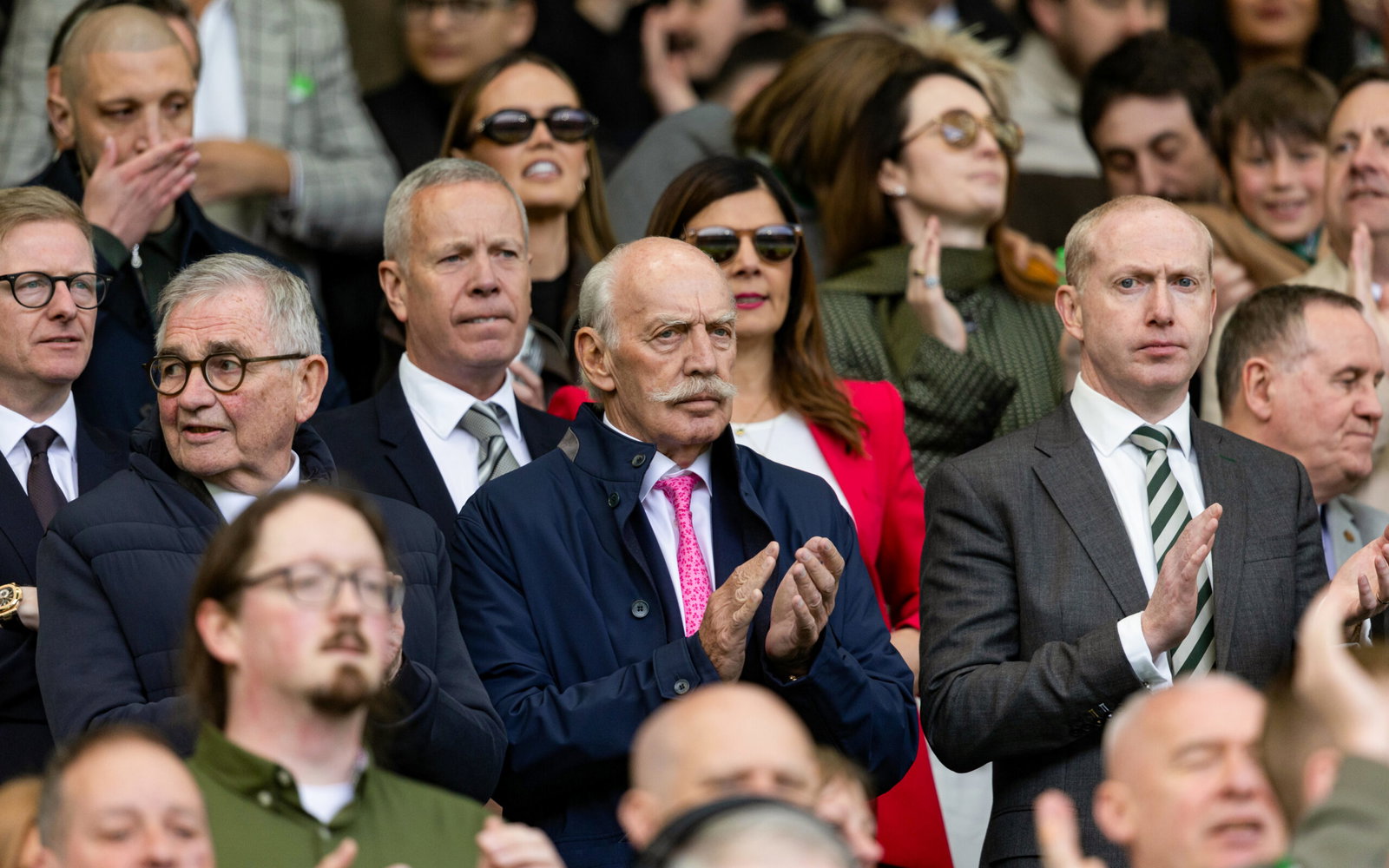
GLASGOW, SCOTLAND - MAY 16: (L-R) Celtic Interim Chairman Brian Wilson, Majority Shareholder Dermot Desmond and Chief Executive Officer Michael Nicholson during a William Hill Premiership match between Celtic and Heart of Midlothian at Celtic Park, on May 16, 2026, in Glasgow, Scotland. (Photo by Craig Foy/SNS Group via Getty Images)
Celtic board members are not there simply to agree with Dermot Desmond. They are directors of a major football institution.
That distinction matters.
Desmond is frequently described as Celtic’s owner or majority shareholder. Neither description is accurate.
He is Celtic plc’s largest individual shareholder and a non-executive director. Yet his influence around Celtic appears enormous.
That raises a simple question. Is there anybody inside Celtic Park prepared to challenge him when they believe a different direction is required?
Celtic board executives have responsibilities
Michael Nicholson is Celtic’s Chief Executive Officer. Christopher McKay is the Chief Financial Officer.
These are not ceremonial positions.
Celtic’s own corporate governance information states that Nicholson and McKay have responsibility for the company’s day-to-day operations.
The board itself has legal and financial responsibility for Celtic plc. It also monitors budgets, strategy, risk and the five-year business plan.
Therefore, these people have responsibilities that extend far beyond implementing the wishes of one shareholder.
Nicholson should be capable of telling any director or shareholder when he believes Celtic’s football operation requires a different approach.
McKay should provide financial leadership. He should also explain what Celtic can responsibly afford and how its resources can support growth.
The chairman and non-executive directors should provide scrutiny, judgement and challenge. That is fundamental to effective corporate governance.
So where is that challenge?
Celtic board must explain the strategy
Celtic reported £67.4million in cash at December 31, 2025. That is an extraordinary financial position for a Scottish football club.
Yet supporters continue watching transfer negotiations drag on.
Mika Baur provides a current example. Celtic have pursued the midfielder, but a deal with Paderborn has proved difficult to complete.
Of course, responsible negotiation matters. Celtic should never simply pay whatever another club demands.
However, there comes a point when caution becomes paralysis.
If a player has been identified, scouted and approved, Celtic need an efficient structure capable of completing that transfer.
If the valuation becomes unreasonable, move immediately to the next target.
Weeks of uncertainty should not become the normal way of operating.
This problem feels bigger than one transfer.
Celtic need elite people leading recruitment, scouting, analytics, communications, finance and football operations.
They also need genuine forward planning.
A club of Celtic’s resources should know its primary targets and alternatives months before a transfer window opens.
Somebody must be prepared to challenge Desmond
This is ultimately why the structure around Desmond deserves scrutiny.
His status as Celtic’s largest shareholder gives him considerable influence. However, influence should never remove the need for constructive challenge.
Nicholson is the CEO. McKay is the CFO chairs the board.
Sharon Brown chairs the Audit and Risk Committee, while other non-executive directors also carry corporate governance responsibilities.
Those positions must mean something.
If every significant decision effectively requires one man’s approval, supporters are entitled to ask why Celtic need such an extensive board structure.
Conversely, if decisions are genuinely collective, the entire board must accept responsibility for the results.
Celtic do not need yes-men. They need leaders prepared to argue their case.
They need people capable of saying: No. This isn’t working. There is a better way.
Celtic’s financial strength should provide a platform for ambition, innovation and intelligent investment.
Instead, too often, supporters see hesitation and frustration.
The whole structure needs examined from top to bottom.
Because the biggest question is no longer simply what Dermot Desmond wants.
It is whether anybody powerful enough inside Celtic is prepared to tell him when they believe he is wrong.

 Bhoycie
 Aodhán Ó Conchobhair
 Eric Knott




This article is spot on, in regards the Celtic board. These guy’s are nothing more than yes men who are fearful of their jobs. I’ve never seen a club like Celtic struggle to get these transfers over the line but selling someone !?!? That’s easy because its money in and it pleases Celtic’s majority shareholder McDerott who’s more interested in playing golf all over the world. Celtic suppoort needs to drive everyone on that board and start by boycotting Celtic park and get this lot out of our club
In a nutshell no, Shitebags everyone of them.