
Sean Dyche Open To Celtic Job – But Is This Really The Direction We Want To Go?
 Aodhán Ó Conchobhair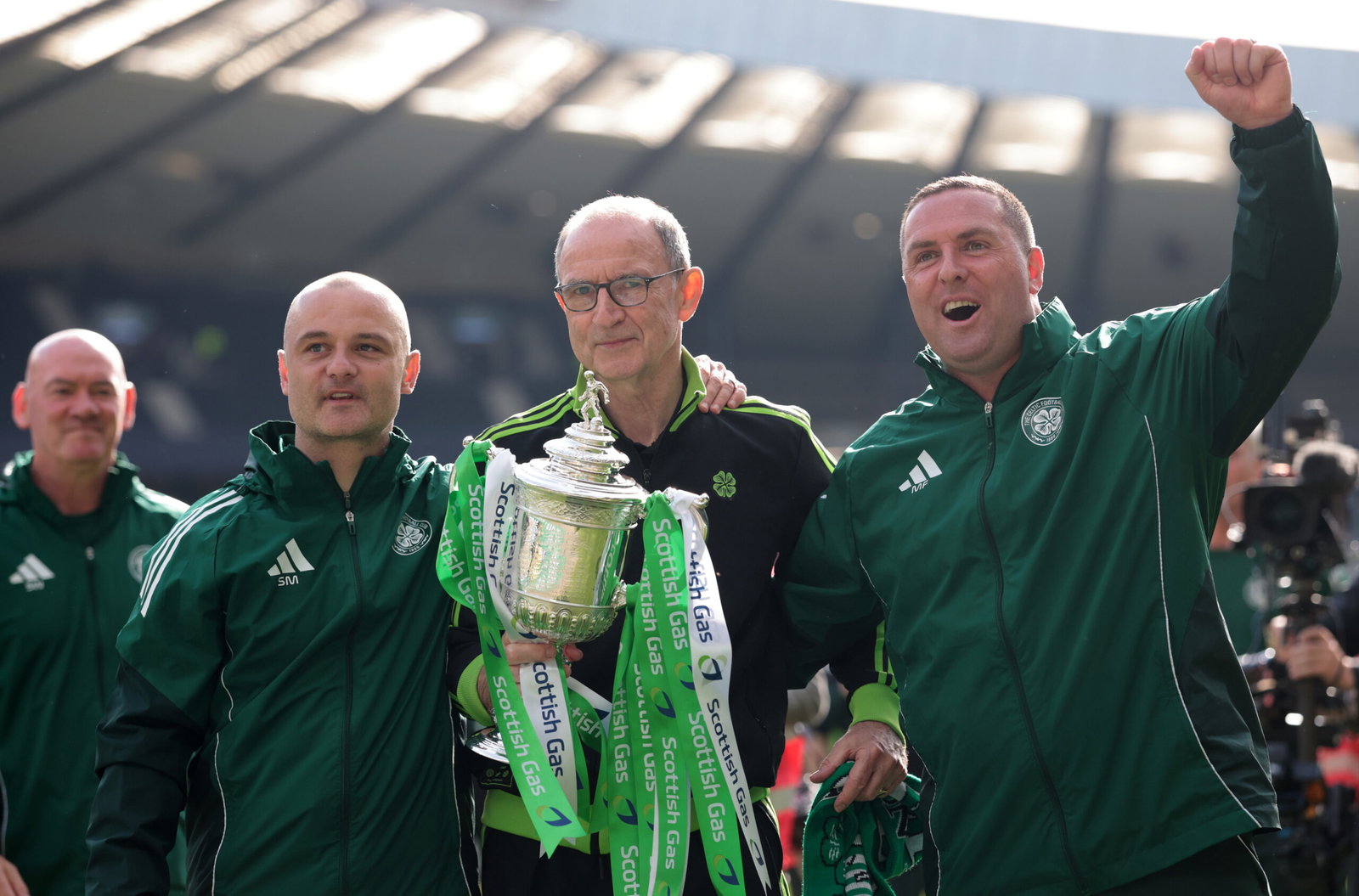
GLASGOW, SCOTLAND - MAY 23: (L-R) Shaun Maloney, Assistant Manager of Celtic, Martin O'Neill, Interim Manager of Celtic, and Mark Fotheringham, Assistant Coach of Celtic celebrate with the Scottish Gas Scottish Cup Trophy after the Scottish Gas Scottish Cup Final match between Celtic and Dunfermline at Hampden Park on May 23, 2026 in Glasgow, Scotland. (Photo by Ian MacNicol/Getty Images)
Well, bhoys, there is another name being thrown into the Celtic managerial conversation, and this time it is Sean Dyche.
According to Football Insider, sources claim Dyche would seriously consider the Celtic job if an offer were made. The same report suggests Martin O’Neill is still expected to see out his contract for now, despite the growing pressure following recent performances and the defeat to Castle Greyskull. Nothing appears imminent, but it is another indication that the club may be preparing for different scenarios behind the scenes.
And that brings us to the obvious question: what exactly are Celtic looking for in their next manager?
Experience is one thing. Ambition is another.
Nobody can question Dyche’s experience of English football. He has managed in the Premier League with Burnley, Everton and Nottingham Forest, and his teams have often been associated with organisation, physicality and a strong work ethic.
Those qualities are not without value. Celtic need a team that can compete consistently, defend properly and show some fight when matches become difficult. Too often recently, we have looked short of confidence and ideas when things have gone against us.
But there is a difference between bringing in a manager who can organise a team and bringing in one who can take Celtic forward in Europe.
That is the challenge facing whoever eventually takes the job.
Celtic should be looking for someone who can win domestically, develop players, improve the squad and give us a genuine plan for European competition. We cannot keep treating the Champions League as a financial target while accepting that our ambitions on the pitch must remain limited.
Would Dyche be capable of delivering that? It is a question worth debating, rather than assuming his Premier League experience automatically makes him the answer.
The bigger issue is still the board.
Let’s not lose sight of the fact that this entire conversation comes amid growing frustration with the direction of the club.
We have watched Celtic struggle for consistency, suffer damaging defeats and leave supporters questioning whether the current setup has the answers. The disappointment is not simply about one result or one manager. It is about recruitment, planning and whether the club has a clear vision beyond winning the league.
Changing the manager might bring a short-term lift, but it will not automatically resolve those problems.
If Dyche were appointed, what backing would he receive? Would he be given the players needed to implement his ideas, or would he be expected to work with a squad that has already left us asking serious questions?
Would the club support him when difficult decisions need to be made, or would we see the same familiar pattern of late recruitment, compromises and excuses?
These are the questions that matter far more than whether a manager is supposedly interested in the job.
We have been here before. A new appointment creates excitement; supporters get behind the team, and then the same structural issues eventually come back into view.
Celtic need a proper footballing plan, not just another name in the dugout.
What would Dyche bring to Celtic?
There are arguments in his favour. He has managed under pressure, worked with different budgets and dealt with the demands of English top-flight football. His sides have often been difficult to play against, and Celtic could certainly benefit from greater defensive organisation and resilience.
However, supporters would also want to know how his approach would translate to Scottish football, where Celtic are expected to dominate possession and break down opponents who sit deep.
Could he build an attacking side capable of entertaining supporters while maintaining the defensive discipline he is known for? Could he improve younger players and help Celtic compete more effectively in Europe?
Those are legitimate questions, and any appointment would need to be judged on the footballing plan presented rather than reputation alone.
There is also the question of what the supporters want. Celtic are not simply looking for someone to steady the ship. We want a team with an identity, players who look properly coached and a manager who understands the expectations that come with this job.
O’Neill’s future remains the immediate question.
For now, the report does not suggest that Dyche is on the verge of taking over. It says he would give an offer serious consideration, while O’Neill remains in position and the board continues to back him publicly.
That distinction matters. There is a difference between identifying a possible candidate and actively negotiating a deal.
O’Neill still has the opportunity to change the mood around Celtic, but the performances must improve. Supporters are not satisfied indefinitely by statements of support from the board if the football continues to fall short.
If the club eventually decides a change is necessary, it must make that decision with a clear idea of what comes next.
No panic appointment. No short-term fix dressed up as a long-term strategy. And certainly no assumption that a familiar Premier League name is enough to convince supporters that everything is suddenly going to be fine.
Dyche may be open to Celtic, but the more important question is whether Celtic have a clear idea of what they want from their next manager.
Because this club should be thinking beyond simply getting through the next few months.
We need ambition, direction and accountability, bhoys. A new manager might be part of the answer, but he cannot be expected to fix a broken plan on his own.
Key Takeaways
- Sean Dyche is being discussed as a potential manager for Celtic, but his suitability remains questioned.
- Celtic needs a manager who can win domestically, develop players, and enhance European competition success.
- There are ongoing frustrations with the club’s direction, focusing on recruitment and long-term vision, not just managerial changes.
- Dyche may improve defensive organisation, but concerns exist about translating his approach to Scotland’s style of play.
- Supporters want a clear footballing plan, accountability, and ambition from the club, not just a new name in charge.




Organisation, PHYSICALITY and a strong work ethic…
Get him in the fu**kin door tomorrow then !
I think we are still the best team in the Spl but o ly because how poor the rest of the teams are The board need to go and get Peole in who are willing to back manager with the finances he needs to compete at European level .